

The African Market Takes The Lion's Share
folder_open East Africa
The rising trade between Dubai and Africa has prompted the Dubai Chamber of Commerce to announce the opening of new offices in Africa. The Dubai Chamber of Commerce already has representative offices in Nairobi (Kenya), Maputo (Mozambique), Accra (Ghana), Johannesburg (South Africa). The mandate of Dubai Chamber offices in Africa is to gather market information and to facilitate bilateral opportunities between Dubai and Africa. To do this, the Dubai Chamber offices in Africa offer a variety of services that helps to promote and represent Dubai in Africa and attract African companies to Dubai More offices might be opened in other key markets in Africa in the coming years. Trade between Kenya and Dubai has been increasing with each passing year. Kenya is the fifth largest economy in Sub-Saharan Africa and a major destination of Dubai’s exports and re-exports. Many companies in Dubai have opened offices in Nairobi or have appointed agents and distributors in Kenya to promote their products and services in the East African nation which is also known as a business and logistics hub of the East African region. sector. The booming tourism industry of Kenya has attracted investors from Dubai. Notable among these are Emaar Properties and the prestigious Jumeirah Group – world renowned developers based in Dubai that have already invested in Kenya’s lucrative hotel sector. "We are looking forward to opening our new office in Africa, in Kenya," said a spokesperson from Dubai Chamber of Commerce. “Kenya is an important trade and investment partner for us as it is strategically located and a member of the East Africa Community (EAC) and the Common Market for Eastern & Southern Africa (COMESA). We believe there are a lot of synergies between Kenya and Dubai in various sectors, such as tourism, ICT, and logistics, and this office will help us strengthen our footprint in the country and the wider region. Mozambique, on the other hand is one of the fastest growing markets in the East African coast. Dubai’s trade with Mozambique has registered an astounding 500 per cent growth in the last decade. “Our decision to open an office in Mozambique is reflective of our aim to increase our footprint in the country and to give the businesses the chance to capitalize on the 250 million strong consumer base as Mozambique will open doors to the wider Southern African Development Community (SADC), for us,” the spokesperson of the Dubai Chamber said. In the reverse direction, Africa’s exports to the UAE have also grown by 11 per cent over the last five years. The UAE is among the top 10 trading partners for several individual African nations and has been a top-three export destination for the entire COMESA bloc for many years. The African continent contains six out of the world’s ten fastest-growing economies and foreign direct investment is unable to cope with the immense opportunities on the ground. The African Development Bank predicts that as much as $155billion needs to be spent in Africa every year on infrastructure till 2040. It is estimated that less than half of this is actually coming through. Established in 1965, the Dubai Chamber of Commerce & Industry is a non-profit public entity, whose mission is to represent, support and protect the interests of the business community in Dubai by creating a favourable business environment, supporting the development of business, and by promoting Dubai as an international business hub..

East and West Africa may be on the same continent, just a few hours' flight from each other, and with complementary economies that make them natural trading partners. Yet, historically, they have remained economically disconnected. With a combined regional population of over 1.2 billion and well-matched resources, East and West Africa have long recorded some of the lowest bilateral trade levels of any regions globally. Transport logistics remain a primary bottleneck. It can still cost twice or thrice as much to fly from East Africa to West Africa as it does to fly from Africa to Europe. While a flight to London boasts multiple daily departures at highly competitive rates, routes connecting East African hubs to West African cities like Dakar or Lagos are often characterized by limited carrier options and higher ticket prices. Communication infrastructure also historically posed a significant hurdle. Although cross-border telephony costs have dropped, physical infrastructure like direct road, rail, or sea links between the two regions remains severely underdeveloped. A logistics analysis highlighted that transporting a container by road across the continent's interior can be exponentially more expensive than shipping the same container from the United Kingdom to West Africa. Dr. Joshua Kivuva, a lecturer at the University of Nairobi, notes that relations between East and West Africa have been historically limited. “Different languages and historical trading routes could also be attributed to the minimum contact between the two regions,” he adds. A UN Economic Commission report previously highlighted that trade among African countries accounted for just a fraction of their total external trade, often losing out to European markets. Because of these systemic hindrances, exports from North and Central Africa would notoriously find their way to European warehouses before being redirected back to other African markets. However, regional economic communities like COMESA (Common Market for Eastern and Southern Africa) and ECOWAS (Economic Community of West African States) have actively worked to reduce trade barriers, bringing tangible benefits in employment and regional incomes. The Dawn of the AfCFTA and Digital Integration The implementation of the African Continental Free Trade Area (AfCFTA) has marked a historic turning point for cross-regional commerce. With 50 nations now having ratified the baseline agreement, the framework is actively dismantling the historical barriers that isolated East and West Africa. By aiming to eliminate tariffs on 90% of goods and establishing the Pan-African Payment and Settlement System (PAPSS), the AfCFTA is laying the groundwork for a unified $3.4 trillion market. Crucially, major economic anchors like Kenya and Nigeria are among the 25 nations that have finalized their Schedules of Tariff Concessions, securing the necessary domestic legal frameworks to allow duty-free trade to flow across the East-West corridor. Simultaneously, the digital landscape is undergoing a critical evolution, transitioning from an infrastructure deficit to a usage challenge. As of 2026, mobile broadband networks cover an impressive 87% of Sub-Saharan Africa’s population, yet only 27% actually use mobile internet. Closing this 60% "usage gap"—which leaves over 710 million people offline despite being within network reach—is the next frontier for the region's economic developers. Addressing device affordability, digital literacy, and data costs will be paramount to unlocking the full potential of digital trade, helping cross-border B2B networks thrive. Did You Know? Over 50 African countries have ratified the African Continental Free Trade Area (AfCFTA), creating a potential $3.4 trillion single market. Kenya and Nigeria are among the 25 nations that have finalized their AfCFTA tariff reduction schedules, opening new cross-continental B2B opportunities. Sub-Saharan Africa's real GDP growth accelerated to 4.5% in 2025, buoyed by reduced macroeconomic imbalances. Despite 87% of Sub-Saharan Africa being covered by mobile broadband, only 27% use mobile internet, leaving a 60% "usage gap". Mobile data traffic per active smartphone in Sub-Saharan Africa is projected to more than triple from 2024 to 2030, reaching 17 GB per month. The Pan-African Payment and Settlement System (PAPSS) will formalize cross-border commerce and bypass the need to route payments through external global banks.

Entebbe Airport Plans Major Expansion
folder_open East Africa
Uganda is making rapid strides to emerge as the premier regional business and logistics hub for the East African Community (EAC). In a concentrated effort to promote regional and international trade, the government has launched several aggressive initiatives to modernize its telecommunications and transport infrastructure. At the forefront of this economic strategy is the massive, multi-phase upgrade and expansion of Entebbe International Airport, designed to transform the facility into a world-class gateway for global passenger and cargo aircraft. Entebbe International Airport lies astride the equator, frequently earning it the title of the “Airport on the Equator.” Elevated at 3,782 feet above sea level, the airport sits on a spectacular peninsula bordering Africa’s largest freshwater body, Lake Victoria. Because Uganda is a landlocked nation, its direct contact with the outside world is heavily dependent on these air connections. Goods are flown directly into Entebbe for further distribution deep into the African interior, making seamless air cargo movement of paramount importance to the overall expansion of the Ugandan economy. Latest Developments at Entebbe Airport Uganda’s aviation sector is currently experiencing a historic boom. In January 2026, the Uganda Civil Aviation Authority (UCAA) officially opened a state-of-the-art, 20,000-square-meter passenger terminal. This massive infrastructure upgrade has increased Entebbe's passenger handling capacity from two million to over 3.5 million travelers annually. The new facility features advanced aerobridges, vastly expanded check-in counters, self-service kiosks, and extended duty-free shopping lounges, ensuring a streamlined and highly efficient experience for international business travelers and tourists alike. Concurrently, the cargo sector has been entirely revolutionized. A newly constructed, Chinese-built cargo center capable of handling 100,000 metric tonnes annually is now fully operational, replacing the outdated 50,000-tonne facility. This modernization immediately yielded results; in February 2026, Entebbe recorded a massive surge in international traffic, handling nearly 190,000 passengers and 4,498 metric tonnes of cargo in a single month. This increased logistical capacity is particularly vital for Uganda's agricultural sector, allowing for the rapid export of highly lucrative, temperature-sensitive cash crops like premium Arabica and Robusta coffee to global markets. Liberalization and Future Growth The need for this expansion has come at a critical and highly appropriate time. Uganda has registered impressive GDP growth over the last decade, successfully keeping inflation under control and attracting significant foreign direct investment (FDI). Consequently, Entebbe has witnessed a substantial rise in the number of international airlines operating daily routes. Recognizing the absolute necessity of regulating the smooth flow of air freight, the Government of Uganda has enacted progressive policy shifts. By changing the taxation basis for air cargo from CIF to FOB, the government aims to drastically boost airfreight volumes and enhance Uganda's global export competitiveness. Furthermore, the liberalization of cargo handling services—abolishing previous monopolies—has successfully attracted top-tier technical and management expertise, eliminating delays and professionalizing ground operations to meet strict international aviation standards. Did You Know? Record-Breaking Traffic: In early 2026, Entebbe International Airport experienced a massive surge in traffic, handling an average of nearly 6,770 international travelers every single day. A New Passenger Terminal: Opened in January 2026, the brand-new 20,000-square-meter terminal has expanded the airport's annual capacity to over 3.5 million passengers. Massive Cargo Capacity: A newly constructed cargo center can now handle 100,000 metric tonnes of freight annually, a massive upgrade from the old 50,000-tonne facility built inside a converted aircraft hangar. The "Airport on the Equator": True to its nickname, Entebbe Airport is located incredibly close to the Earth's equator, sitting on a picturesque peninsula overlooking Lake Victoria. A National Carrier Revival: As part of the airport's expansion master plan, state-of-the-art headquarters are being constructed to serve as the primary operational base for the national carrier, Uganda Airlines.
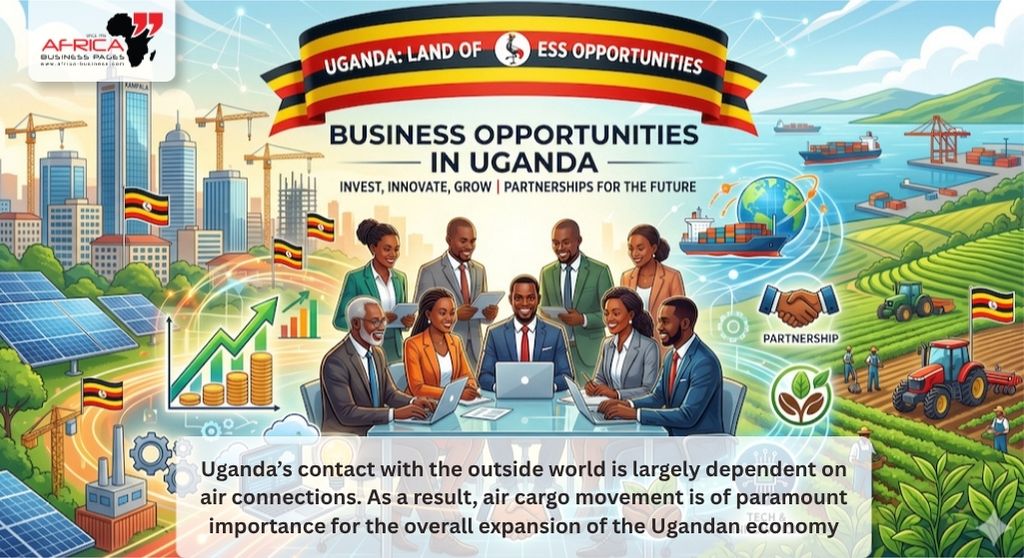
Business Opprtunities in Uganda
folder_open East Africa
Uganda is making rapid strides to emerge as one of the leading commercial and logistics centers in East Africa. Realising the importance of Uganda as one of the most progressive and dynamic economies in Sub-Saharan Africa, foreign direct investment and international trade partnerships are surging. This was highly evident at the recent Uganda International Trade Fair held in Kampala, where hundreds of participants from over 35 countries—including a massive contingent from the Middle East—gathered to promote their products in this lucrative frontier market. Moving far beyond its historical hardships, Uganda today boasts a highly stable political and macroeconomic environment characterized by low inflation, stable exchange rates, and consistently robust economic growth. It consistently ranks among the fastest-growing economies in East Africa. The government is actively working to better the lives of its citizens by establishing a viable, investor-friendly commercial market. As an anchor member of the integrated East African Community (EAC), Uganda plays a pivotal role as the primary trade and distribution hub connecting coastal ports to the resource-rich African hinterland. The country undeniably has the political will, the natural resources, and the infrastructure to cement its status as a premier business destination in Africa. To sustain this growth, Uganda has invested billions into the development of its national infrastructure. Uganda’s modernizing road and rail systems are increasingly well-linked to its principal trading partners, Kenya and Tanzania, facilitating bulk cargo transportation. Furthermore, the aviation sector has seen massive upgrades. Entebbe International Airport, located 40 kilometers south of Kampala on the picturesque shores of Lake Victoria, has undergone multi-phase expansions. It now serves as a critical regional hub, handling high volumes of international passenger and cargo traffic. Top-tier international carriers, including Emirates, British Airways, and Ethiopian Airways, operate regular flights, rapidly expanding Uganda's global connectivity. “We are committed to improving the incentive structure and streamlining bureaucratic procedures in order to make Uganda highly competitive as an investment location for global capital. The Government will continuously work on improving the infrastructure to support private enterprise.” — President Yoweri Museveni. Bi-lateral trade between Uganda and the United Arab Emirates has registered explosive growth over the last five years. The economic liberalisation policies adopted by the Ugandan government, coupled with strategic geographic proximity and daily direct flights, have played an instrumental role in promoting direct B2B trade and investment pipelines between the two nations. Uganda Real GDP Growth Projections (2023 - 2030) Data Source: International Monetary Fund (IMF) / World Bank | © Africa Business Pages Uganda's Growth Drivers Uganda's economic landscape is experiencing a transformative phase, with real GDP growth projected to surge past 9% by 2026–2027. This unprecedented acceleration is heavily driven by the onset of commercial oil production from the Lake Albert region, alongside a robust performance in the manufacturing and construction sectors. Foreign direct investment is flowing into critical infrastructure, paving the way for the nation to achieve its Vision 2040 ambitions of reaching high-income status. Furthermore, Uganda is capitalizing on the massive opportunities presented by the African Continental Free Trade Area (AfCFTA). The government is aggressively diversifying exports beyond traditional commodities like coffee, investing heavily in agro-industrialization, digital infrastructure, and renewable energy. By streamlining cross-border trade through One-Stop Border Posts (OSBPs) and enhancing domestic revenue mobilization, Uganda has successfully stabilized inflation below 4% and maintained significant exchange rate stability, cementing its position as a highly lucrative and stable anchor market in East Africa. Did You Know? The Pearl of Africa: Uganda was famously dubbed the "Pearl of Africa" by Winston Churchill due to its magnificent beauty, rich biodiversity, and fertile landscapes. Coffee Powerhouse: Coffee is of fundamental importance to the economy. Uganda is Africa's largest exporter of coffee, growing highly sought-after Robusta and Arabica beans that support millions of rural farmers. Young and Dynamic: Uganda boasts one of the youngest populations in the world, with a median age under 17, providing a massive demographic dividend for future consumer markets and a dynamic labor force. The Oil Boom: With the ongoing development of the Lake Albert oil reserves and the East African Crude Oil Pipeline (EACOP), Uganda is transitioning into a major African oil exporter.
Preliminary request for participation in the trade show
place
calendar_today
Preliminary request for visitor registration
Visitor Registration
place
calendar_today