

The Nigerian government recently revised its fiscal policy, aligning tariffs with the 2026-2027 ECOWAS Common External Tariff (CET) framework. The government hopes that these new Import Adjustment Taxes (IAT) will revitalise the local tyre manufacturing industry, increase employment, and effectively block the influx of unregulated sub-standard tyres from overseas markets.
A few years back, inconsistent tariff structures and high energy costs had led to massive losses for tyre manufacturers based in Nigeria. Many prominent brands relocated their factories to neighbouring West African countries to avoid the fierce price competition they faced from unregulated used-tyre imports arriving from places like Dubai, India, the Far East, and China.
 Historically, the lowering of import duties on tyres had an adverse
effect on domestic companies in Nigeria. Decades ago, local production stood at 2.25 million
units, but as cheaper imports flooded the market, major legacy plants, such as Dunlop's Nigerian
operations, witnessed a sizeable decline in turnover and ultimately ceased local manufacturing operations.
Historically, the lowering of import duties on tyres had an adverse
effect on domestic companies in Nigeria. Decades ago, local production stood at 2.25 million
units, but as cheaper imports flooded the market, major legacy plants, such as Dunlop's Nigerian
operations, witnessed a sizeable decline in turnover and ultimately ceased local manufacturing operations.
As per the latest 2026 industry statistics, the tyre market in Nigeria is expanding rapidly driven by a 40 million-strong vehicle fleet. According to recent studies, the Nigeria tyre market is valued at $0.82 billion and is expected to surpass $1.19 billion by 2031 at a robust CAGR of 6.4%.
It is widely believed that previous dependence on uncontrolled used tyre imports had a negative socio-economic impact, including the heavy loss of local manufacturing jobs across Delta, Edo, and Ogun States, alongside a severe drain on foreign exchange reserves. Today, government crackdowns and rigorous enforcement by the Standards Organisation of Nigeria (SON) are actively reshaping the landscape to prioritize road safety and new tyre imports.
The global tyre market is currently projected to reach an astronomical $271 billion, reflecting a massive global volume of 4.6 billion units. The Nigerian market size commands a highly lucrative $0.87 billion (as of 2026), heavily characterized by premium radials and commercial vehicle tyres, which boast a projected annual growth rate of over 6%.

Latest Trade and Policy Developments
In a bold move to stabilize the domestic automotive sector and protect consumers, the Nigerian government aggressively tightened its grip on the market in early 2026 by strictly enforcing the ban on used and retreaded tyre imports (with the exception of large heavy-duty truck tyres). This regulatory crackdown effectively wiped out a massive portion of the unsafe, low-cost budget segment, nudging consumers back toward purchasing brand-new replacement tyres. The revised 2026 fiscal policy measures also introduced targeted tariff reductions on automotive assembly inputs, making local vehicle and component assembly much more cost-effective.
These improved economic indicators and protective policies have renewed foreign confidence in the nation's mobility sector. Most notably, French tyre giant Michelin announced a strategic comeback to the Nigerian market after an 18-year absence from direct local operations. By establishing a direct localized footprint and focusing heavily on premium passenger car radials, SUV fitments, and customer safety education, multinational brands are now positioning themselves to capture the rising demand fueled by Nigeria's expanding middle class and sprawling road infrastructure projects.
The Nigerian market has become the most sought after for international tyre manufacturers on the continent because of its huge market potential. Despite FX challenges and inflation constraints, the demand for reliable mobility solutions ensures continuous long-term volume sales.
Till recently, there were a few locally established tyre manufacturers in Nigeria, but erratic power supply problems in the country forced most of these tyre manufacturers to relocate. This, in turn, created a highly thriving market for foreign brands and international wholesalers looking to sell tyres directly to Nigerian B2B buyers.
Demand for Tyres in Nigeria
Majority of the motor vehicles entering the Nigerian automotive market are imported used vehicles from Europe and the U.S.A., thus, the Nigerian tyre market is heavily driven by the demand for aftermarket replacement tyres. Two-wheeler tyres capture a massive majority of the volume share due to the high popularity of motorcycles and tricycles. However, the passenger car, truck, and buses tyre segments hold the highest revenue shares owing to higher unit prices and the prominent use of commercial transport networks.
Based on types, radial tyres comprehensively dominate the Nigeria tyre market (accounting for over 79% of the market), due to advantages such as higher fuel-efficiency and longer tread life. Some of the key players driving the Nigeria tire market are Goodyear, Pirelli, Continental, Bridgestone, Michelin and leading value-driven Chinese manufacturers.
Africa Tyres Dealers Directory: Database of Tyre Importers in Africa
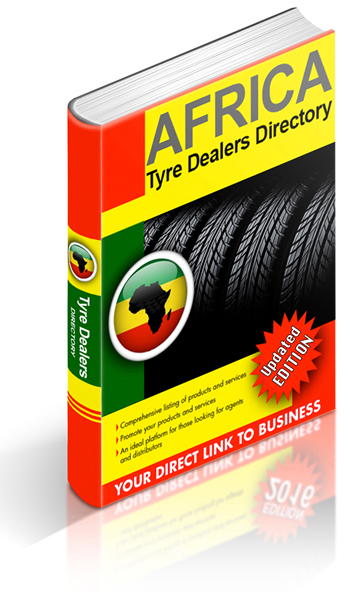 In a bid to help tyre
manufacturers and suppliers find importers, wholesalers, dealers and agents in
Africa, the African Business Pages has compiled a special directory that lists tyre
importers in over 24 African countries. The Africa
Tyre Dealers Directory is now available as a digital download at a nominal
price and has played an instrumental role in promoting direct B2B contact between
African tyre importers and tyre manufacturers and suppliers from all across the
world.
In a bid to help tyre
manufacturers and suppliers find importers, wholesalers, dealers and agents in
Africa, the African Business Pages has compiled a special directory that lists tyre
importers in over 24 African countries. The Africa
Tyre Dealers Directory is now available as a digital download at a nominal
price and has played an instrumental role in promoting direct B2B contact between
African tyre importers and tyre manufacturers and suppliers from all across the
world.
The Africa Tyre Dealers Directory has been adapted for online distribution and is now available in Excel format as an instant digital download from Africa Business Pages. The Africa Tyre Dealers Directory has served as a useful database for those wanting to export tyres to Africa and to reach potential buyers in Africa. You can download the directory HERE.
Did You Know?