
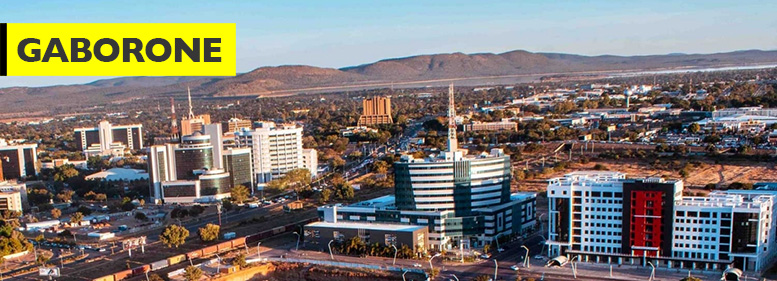
In a recent report in the Foreign Policy magazine, the Carnegie Endowment for International Peace has ranked Botswana at number one (1) in Africa in its "Globalisation Index". Among the countries classified as “developing”, Botswana was ranked number three (3) after Malaysia (20) and Panama (27) and just ahead of Republic of (South) Korea (32). The other African states that were ranked in the index’s top 50 were: Tunisia (35), Uganda (38), Senegal (40), Nigeria (42), Morocco (47), and South Africa (49).
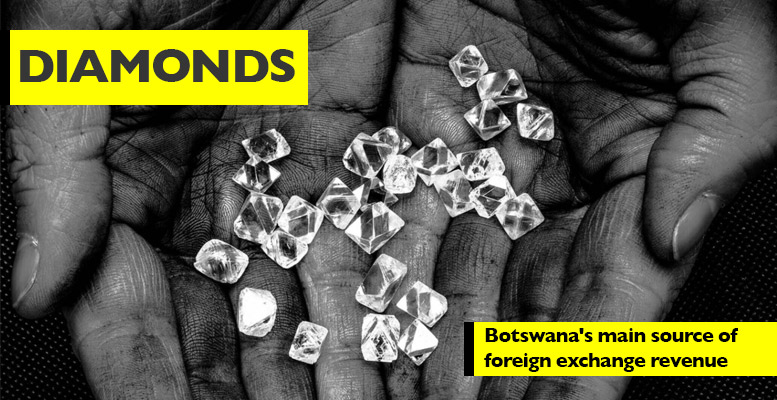
Botswana's main sources of foreign exchange revenue are diamonds, copper-nickel, and
beef. Strong increases in
diamond revenues have enabled Botswana to continue its impressive rates of
economic growth,  averaging
12.9 percent since
1965. Judicious economic management has kept Botswana from the blunders committed by
many developing countries.
averaging
12.9 percent since
1965. Judicious economic management has kept Botswana from the blunders committed by
many developing countries.
However, in recent times manufacturing is also growing in importance. It is estimated that approximately one-eighth of Botswana's revenues come from customs duties. On the other hand, cattle are the economic backbone of the country's large rural population. In fact, more than 50 per cent of Botswana's population makes its livelihood from raising stock. Surprising as it may be, cattle outnumber people in Botswana by a ratio of about two to one.
Botswana's membership in the Southern African Customs Union (SACU), which also includes Lesotho, Namibia, South Africa and Swaziland, allows its products to be exported duty-free to the 35 million inhabitants of those countries. Botswana plays a leading role in the Southern African Development Coordination Conference (SADCC), an economic organization of all the black-ruled countries of southern Africa. Botswana also enjoys duty-free access to the European Community for many of its products. The Generalized System of Preferences (GSP) also permits duty-free entry to the United States from Botswana for a list of some 3,500 items.
The Diamond Centre of Africa
The ambition of the Botswana government is to establish Botswana as the major diamond center of the world. Being the world's largest diamond producer was not in itself enough and the country's ambition is to develop many other diamond-industry competencies.
Recent developments have moved Botswana closer to its ambition: one being De Beers' aggregation announcement and the other being the establishment of the Diamond Technology Park, which would mean that Botswana would have facilities that would not only service the Botswana diamond industry, but also the diamond industry of the world by adding value to diamonds within Botswana.
Modelled on similar successful international developments, the concept of the  diamond technology park was
that of a supply-chain cluster that could house the entire diamond industry in a
centralized, finite manner. The park
is being built in phased developments, creating opportunities for small, medium and
micro enterprises.
diamond technology park was
that of a supply-chain cluster that could house the entire diamond industry in a
centralized, finite manner. The park
is being built in phased developments, creating opportunities for small, medium and
micro enterprises.
With half of the diamond industry involving services, the creation of the Diamond Technical Park would have an economic multiplier effect and would involve Botswanans in services enterprises. The technology park also had potential to provide work for Botswana's educated population, which had lacked opportunity.
Botswana aims to transition from an upper-middle-income country to a high-income country by 2036, though it currently faces significant headwinds from over-dependence on mining
Diamond Technology Park tenants are being drawn from the world's leading diamond companies, which have superior levels of expertise and solid experience. Other tenants would include companies that serviced the diamond-manufacturing industry such as banks, courier companies, machinery suppliers, information-technology companies, cleaning companies, security firms, a laboratory, restaurants, retail shops and self-catering accommodation.
Customes & Excise Duties
In general, goods imported into Botswana from outside the Southern African Customs Union - SACU (Botswana, Lesotho, Namibia, South Africa and Swaziland) attract customs duties at rates outlined in the Customs Tariff Book. Customs duties are paid against a prescribed declaration form formally known as a bill of entry, form BW500. A tariff book as well as a goods code book is available for sale at all regional Customs and Excise offices. There are some provisions in the Customs Tariff Book and Value Added Tax (VAT) Act exempting payment of certain customs and excise duties as well as VAT (10%) on raw materials imported by registered manufacturers or industries.